















Introduction
Running a bakery manufacturing business comes with its own set of challenges.
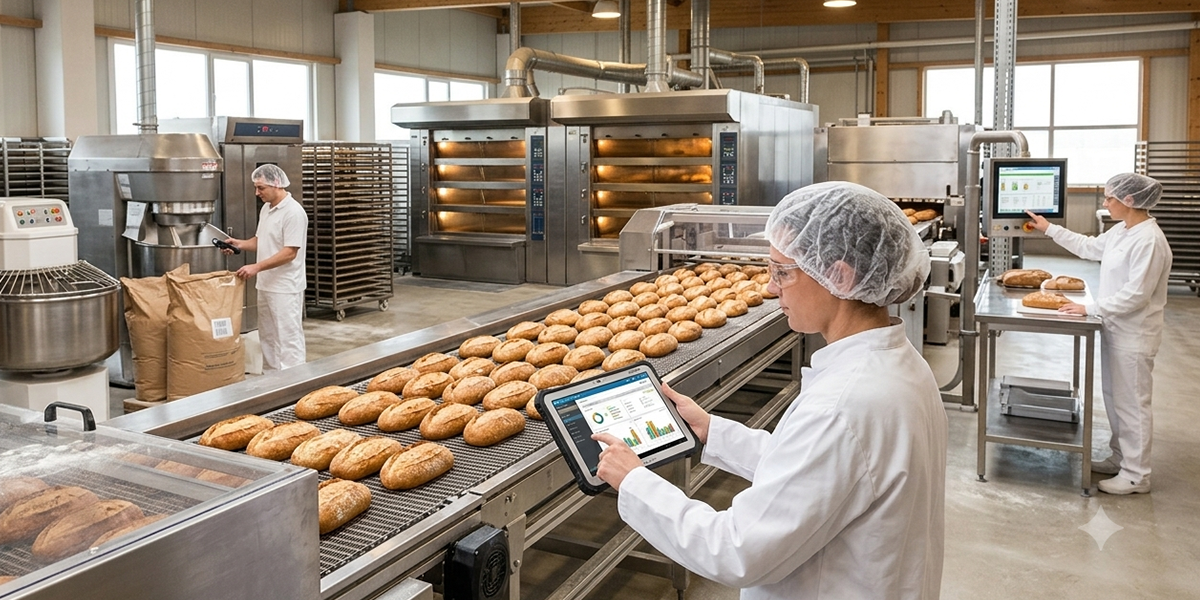
From bread and buns to cakes, cookies, pastries and croissants, every product goes through the same core journey: dough or batter is mixed, proofed or rested, baked at a specific temperature for a specific time, cooled, sliced or depanned, and packed.
Customers expect the same crumb, crust colour, rise and taste every single time. But holding that consistency across shifts, ovens and SKUs, while juggling perishable ingredients, tight baking windows, and rising costs, gets harder as the business grows.
This is where an integrated ERP system can help. An ERP for bakery industry brings key manufacturing activities together, giving teams better visibility across recipes, proofing and baking schedules, materials, inventory, quality, costing, and traceability.
Why Is Bakery Manufacturing So Complex?
The bakery manufacturing process may look simple from the outside — mix, proof, bake. In reality, each of those steps has to happen within a narrow window of time and temperature, or the finished product suffers.
A small change in hydration, proofing temperature, or baking time can affect the finished product, and common bakery manufacturing challenges like these, result in manual processes that can create gaps.
Recipe Consistency Across Production Batches
A bakery product depends on the right flour-to-water ratio, yeast activity, kneading time, and process conditions.
Even a small variation can affect taste, texture, crumb structure, crust colour, or rise. A 2°C shift in proofing temperature, or a few minutes’ difference in baking time, is often enough to turn a loaf dense instead of light, or a croissant flat instead of flaky and laminated.
As a bakery grows, recipe management becomes more difficult. Manufacturers may need to manage:
- Multiple product formulations (bread, buns, cookies, cakes, pastries)
- Different batch sizes
- Proofing time and temperature ranges
- Baking time and oven temperature by product
- Ingredient substitutions
- Nutritional and allergen information
- Product specifications
When this information is kept in separate spreadsheets or documents, it becomes harder to make sure everyone is using the latest approved recipe, right down to exact proofing temperature and baking time.
A centralised approach to recipe management can help production teams work from controlled and approved formulation information, batch after batch.
Managing Perishable Ingredients
Bakery ingredients can have very different shelf lives and storage requirements. Flour and sugar can be stored for weeks; fresh yeast, butter, cream, and egg-based fillings cannot.
Manufacturers need to know what is available, which lots are being used, and which materials are close to expiry.
Key considerations include:
- Ingredient availability (flour, yeast, butter, dairy, fillings)
- Expiry dates on perishables like yeast and cream
- Cold-storage and stock rotation for butter and dairy
- Storage requirements
- Raw-material costs
- Production requirements
Too much stock can lead to expiry and waste, particularly for butter, cream, and fresh fillings. Too little stock can delay a scheduled baking run. Both can affect margins.
For this reason, inventory management needs to work closely with purchasing and production planning. Humidity during the monsoon months can also affect flour and yeast performance, adding another layer of unpredictability to stock planning across much of India.
Balancing Demand With Production Capacity
Demand does not always follow a fixed pattern. Seasonal periods, retail orders, promotional campaigns, and customer requirements can quickly change how much a bakery needs to produce.
For example, demand for cookies, cakes and festive breads may spike sharply around Diwali or Christmas. A retailer may also place a large order with a short lead time, leaving the production team with limited time to prepare the required quantity.
Bakeries therefore need to balance what customers want with what the ovens, mixers and proofers can actually deliver.
This means considering:
- Seasonal demand: Plan ahead for periods when demand is expected to increase and make sure ingredients and packaging materials are available before production begins.
- Retail orders: Factor confirmed and expected retail orders into production schedules so required quantities can be baked and dispatched on time.
- Promotional demand: Consider the likely increase in orders from discounts, campaigns, or special offers before committing oven and proofer time.
- Short lead times: Check whether materials, labour, and oven capacity are available when urgent orders come in.
- Production capacity: Plan around available shifts, labour, mixers, proofers, and oven decks rather than scheduling more baking than the facility can handle.
- Oven and equipment availability: Consider which deck ovens, tunnel ovens, mixers, and proofing chambers are available when deciding when and how much to bake.
Without this level of planning, a bakery may accept an order it cannot fulfil on time, overload an oven, or create unnecessary inventory.
This makes bakery production planning a balancing act. A connected system can help planners view demand, materials, oven capacity, and schedules together and create more practical production plans.
Controlling Production Costs
Ingredient prices can change — flour, sugar and especially butter and dairy are prone to volatility. Packaging costs can change. Yields can vary between batches depending on proofing conditions and baking loss.
Labour and other production costs, including hand-finishing work like icing, glazing, or laminating pastry, also contribute to the final cost of a product.
Manufacturers therefore need to understand both planned and actual production costs. If costing is based only on old flour or butter prices, it can be difficult to know whether a product is still delivering the expected margin.
An integrated system can connect recipe quantities, material costs, production information, and other relevant costs to provide a clearer view of batch and product costs.
Maintaining Food Safety and Product Quality
Quality needs to be checked throughout production, not only after the product comes out of the oven.
Depending on the product, manufacturers may need to monitor factors such as:
- Ingredient quality
- Proofing and oven temperature
- Moisture content
- Crust colour and unit weight
- Processing conditions
- Allergen information (gluten, dairy, egg, nuts, soy)
- Nutritional properties
These checks should be linked to the relevant batch wherever possible, ideally at defined critical control points across mixing, proofing, baking, and cooling.
This gives production and quality teams a clearer record of what was checked, when it was checked, and whether the batch met the required specifications before it was packed.
Ensuring Traceability
Traceability becomes particularly important when a quality or food safety issue, such as a suspected allergen cross-contamination or an off-spec flour delivery, needs to be investigated.
Manufacturers should be able to answer two basic questions:
Where did this ingredient come from?
Which finished products used it?
To answer these questions, the business needs a clear connection between suppliers, ingredient lots, production batches, finished goods, and dispatch records.
The stronger this connection is, the easier it is to investigate an issue and identify the products or materials that may be affected.
What Happens When Bakery Manufacturing Is Managed Manually?
Spreadsheets are not always a problem.
For a small operation baking a limited range of breads or cookies, they may work well enough. But as production grows across more ovens, more shifts, and more products, the number of records, people, and processes also grows.
That is when manual systems can start creating gaps.
Recipe Data Becomes Difficult to Control
Different spreadsheets, files, and versions can make it difficult to know which recipe, and which proofing time or baking temperature, is current.
A centralised recipe record gives teams one place to work from and helps reduce version confusion between, say, last month’s croissant lamination process and this month’s revised one.
It can also make it easier to control approved formulations and ensure production teams are working from the information they are expected to use.
Inventory Information Is Not Always Reliable
Manual stock updates may not reflect what is actually happening on the shop floor. Butter may have been drawn for a batch but not recorded yet, or yeast approaching expiry may be missed.
This can lead to shortages, excess stock, and avoidable waste, particularly for short-life items like fresh yeast and dairy.
For bakery manufacturers working with perishable materials, a delay in inventory information can affect both production and purchasing decisions.
Production Planning Becomes Reactive
When demand, inventory, and oven schedules are kept separately, planners have to bring the information together before they can create a baking schedule.
This can make bakery production planning slower and less responsive.
Instead of planning ahead, teams may spend more time reacting to material shortages, schedule changes, urgent orders, or oven and equipment constraints.
Costing Takes Too Much Manual Effort
Ingredient prices, yields, packaging costs, labour, and other production costs can change over time, and butter or dairy prices in particular can move quickly.
Updating product costs manually can therefore become repetitive.
It can also make it difficult to compare planned costs with actual batch costs and understand why a product’s margin has changed.
Traceability and Recalls Become Time-Consuming
If ingredient and production records are stored across multiple files, tracing a lot, say a delivery of wheat flour, through the manufacturing process can involve manual checking.
A quality investigation may require teams to find:
- The supplier
- The raw-material lot
- The production batch
- The finished product
- The affected inventory
- The customer or dispatch record
The more disconnected the records are, the longer this process can take.
Management Lacks Real-Time Visibility
Management needs answers to simple questions:
- What are we baking today?
- Which ingredients are running low?
- Which materials are close to expiry?
- Which batches have passed quality checks?
- What is the actual cost of a product?
- Where is finished inventory stored?
- Which products are linked to a particular ingredient lot?
If answering these questions means checking several spreadsheets or asking different teams, it becomes harder to get a complete picture.
How Can ERP Improve Bakery Manufacturing Operations?
The value of ERP is not only about reducing manual work.
It is about connecting the information that moves from one manufacturing activity to another, from flour delivery to the moment a loaf is packed.
An ERP for bakery manufacturing can bring recipes, planning, materials, production, quality, inventory, costing, and traceability into one connected system.
Connect Recipes With Production
Approved recipes and formulation information, including proofing temperature, baking time, and hydration ratios, can be linked with production planning and batch manufacturing.
This helps production teams work with controlled recipe information and the required ingredient quantities, so a whole wheat loaf baked on Monday matches the one baked on Friday.
It also reduces the need to copy information from one file to another and helps keep formulation and production information connected.
Connect Demand With Material Planning
Production needs the right materials, flour, yeast, butter, fillings, at the right time.
ERP can connect demand and planned production with material requirements, helping teams understand what ingredients and other materials are needed for the coming week’s baking schedule.
The system even has AI-based forecast calculations
This can support:
- Better purchasing decisions
- Fewer material shortages mid-bake
- Better inventory planning
- Reduced unnecessary stock
The benefit is not simply having a list of materials. It is being able to relate material requirements to what the business actually plans to bake.
Connect Inventory With Production
Inventory information becomes more useful when it is linked to production requirements.
Manufacturers can have better visibility into:
- Ingredient availability
- Lot information
- Expiry dates, especially for yeast, butter, and dairy fillings
- Material consumption
- Finished goods
- Stock across locations
For businesses handling perishable materials, this information can support better stock rotation and purchasing decisions.
It can also help production teams understand whether the materials needed for a planned baking run are available before the mixers start.
Connect Production With Quality
Quality checks can be built into the manufacturing workflow instead of being kept as separate records.
Required inspections, moisture content, crust colour, unit weight, and temperature at proofing and baking, can be recorded against the relevant production batch or stage.
This gives production and quality teams a clearer view of batch status and helps keep quality information connected to the product being baked.
Connect Ingredients With Finished Products
A simple traceability chain looks like this:
Supplier Lot → Ingredient → Production Batch → Finished Product → Customer
With these links recorded in one system, manufacturers can trace materials in both directions.
Let’s assume that a bakery uses flour from Lot FL-245 to make Batch B-102 of whole wheat bread, proofed at 26–28°C and baked for 35 minutes.
Flour Lot FL-245 → Batch B-102 → Whole Wheat Bread
If the flour has a quality issue, the bakery can identify the affected bread batch. If there is a problem with the bread, they can trace it back to the flour lot.
This helps teams quickly find where a problem started and which products it affected.
Connect Manufacturing Costs With Business Decisions
When recipe, inventory, and production information are connected, manufacturers can get a clearer view of product and batch costs, right down to the cost of butter in a batch of croissants.
This helps teams understand how changes in ingredient prices, yields, packaging, labour, and other production costs can affect margins.
It also gives management better information when reviewing pricing, product profitability, and production performance.
What Does an Integrated Bakery Manufacturing Process Look Like?
Instead of looking at ERP as a list of separate features, it is better to look at how information moves through the complete manufacturing process, from dough to dispatch.
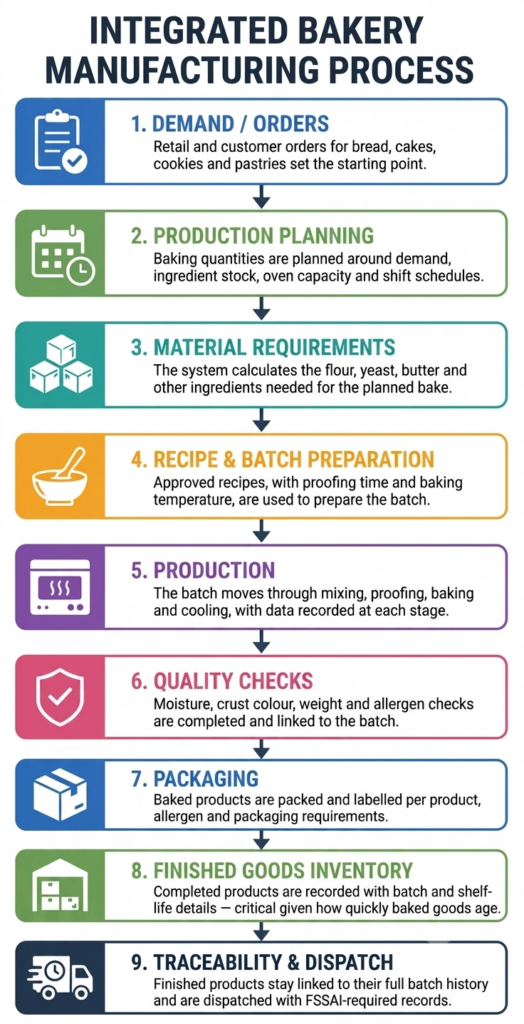
In a bakery, production stage itself covers mixing and kneading, proofing or fermentation, baking at the specified oven temperature and time, cooling, and slicing or depanning, before the batch ever reaches quality checks and packaging.
The key idea is simple: each stage is connected, so information does not have to be entered and checked repeatedly across different systems.
7 Business Outcomes Bakery Manufacturers Can Achieve With ERP
The real value of ERP lies in the day-to-day improvements it can bring, highlighting the key ERP benefits for bakery manufacturers.
1. More Consistent Production
Controlled recipes and standardised proofing and baking parameters can help teams maintain consistent crumb, crust, and rise across batches.
This is especially useful when the same products, say, a signature multigrain loaf, are baked across different shifts or ovens.
2. Better Ingredient Utilisation
Better visibility into stock, shelf life, and production requirements helps manufacturers make more informed decisions about purchasing and ingredient use, particularly for short-life items like yeast and butter.
The aim is simple: Keep the right materials available without building unnecessary stock.
3. Less Production Waste
Waste can come from expired ingredients, incorrect quantities, over-proofed dough, excess production, and poor planning.
Connected production and inventory information can help teams identify where these issues are happening and take action.
4. Better Production Planning
Good bakery production management requires more than knowing how many loaves or trays of cookies need to be made.
Planners need to consider demand, materials, oven and mixer capacity, proofer availability, and schedules together.
For example, producing a large festive-season order may look possible based on quantity alone, but the required oven decks, proofing chambers, labour, ingredients, and available baking time also need to be considered.
An integrated system provides this information in one place, helping teams create more practical production plans and respond when demand changes.
5. Faster Traceability and Recall Response
When supplier lots, ingredients, production batches, and finished products are connected, teams can quickly identify which batches are affected by a quality issue, such as a flour delivery flagged for contamination.
Instead of checking multiple files to trace product history, they can find the required information in one place. This helps manufacturers respond faster, limit the scope of a recall, and reduce disruption.
6. Better Cost and Margin Visibility
Ingredient prices, particularly butter and dairy, packaging costs, labour, and production yields can all affect the cost of a product.
With connected costing data, manufacturers can see how these changes affect batch costs and product margins. This helps them identify rising costs and make better pricing and production decisions.
7. Better Management Decision-Making
Management needs a clear view of production, inventory, quality, and profitability to make informed decisions.
With connected data, they can see how these areas affect each other, identify issues faster, and make decisions based on a more complete picture of the business.
Bakery ERP vs. Spreadsheets: When Should You Make the Move?
Spreadsheets can work well for smaller bakery operations. But as production becomes more complex, across more products and more ovens, managing everything manually can become difficult.
Spreadsheets May Work When…
- Production is very small
- The product range is limited
- One location is involved
- Few people manage production
- Traceability requirements are limited
ERP Becomes More Valuable When…
- Product SKUs are increasing (breads, cakes, cookies, pastries all at once)
- Multiple recipes or variants are maintained
- Production runs across multiple shifts or oven lines
- Ingredient inventory, especially perishables, is becoming difficult to control
- Multiple warehouses or locations are involved
- Traceability requirements are increasing
- Product costing is becoming more complex
- Manual reporting is consuming significant time
- The business is expanding into private-label or contract manufacturing
The decision is not simply about whether spreadsheets can still be used. It is about whether they provide the visibility, control, and scalability the business needs as it grows.
What Should Bakery Manufacturers Consider Before Choosing an ERP?
Choosing an ERP is not just about comparing features. Bakery manufacturers should look at how well the system fits their production processes, manufacturing models, business growth, financial systems, and operational needs.
These factors can also help manufacturers understand how ERP helps bakery manufacturers and determine whether a system is the right fit for their business.
Does the ERP Understand Batch-Based Manufacturing?
Bakery production depends on recipes, proofing and baking parameters, ingredients, batch sizes, yields, and production stages.
The ERP should be designed to manage these requirements and maintain a clear link between materials, production, and finished products.
Can It Adapt To Your Production Process?
Different bakeries may have different products, recipes, equipment (deck ovens vs tunnel ovens), production stages, and operating methods, including hand-finishing steps like icing or lamination.
The system should be flexible enough to support the way your business works rather than forcing teams to manage important steps outside the system.
Can It Scale With Your Product Portfolio?
More products mean more recipes, variants, packaging formats, customers, and production requirements.
The ERP should be able to support this growth without creating more disconnected processes.
Can It Integrate With Existing Financial Systems?
Your manufacturing and financial data should work together.
Check whether the ERP can integrate with the financial system you already use, so production and accounting data can flow between systems with less duplicate entry.
Check whether it allows integrations with systems including Tally, QuickBooks, Sage, and SAP Business One.
Can It Support Multiple Manufacturing Models?
If your bakery serves different types of customers, check whether the ERP can support the models you operate:
- Own-brand manufacturing — Producing and selling your own products.
- Private-label manufacturing — Producing products under another company’s brand.
- Contract manufacturing — Producing goods on behalf of another business.
This becomes especially important as the business expands into new manufacturing models.
What Implementation and Support Does the Vendor Provide?
ERP implementation is more than installing software.
Manufacturers should consider:
- Process assessment
- Data migration
- System configuration
- User training
- Testing
- Ongoing support
A system may have the right features, but successful implementation also depends on how well it is configured and adopted by the teams using it.
Can the System Be Deployed in the Cloud or On-Premise?
The right deployment option depends on the company’s IT setup, operational needs, data requirements, and long-term plans.
Both cloud and on-premise options may be suitable, depending on the business.
When Is It Time for a Bakery Manufacturer to Consider ERP?
A bakery manufacturer should consider ERP when manual processes start creating repeated problems.
Common signs include:
- Recipe inconsistencies (a batch that just doesn’t rise the way it should)
- Ingredient shortages
- Expired inventory, especially butter, yeast, or dairy fillings
- Excess production waste
- Difficulty calculating product costs
- Manual production scheduling
- Slow traceability
- Repeated quality issues
- Spreadsheet-based reporting
- Difficulty scaling production
You do not need to wait until every process becomes difficult.
If teams are spending too much time searching for information, updating spreadsheets, or fixing errors between departments, it may be time to evaluate an integrated system.
Explore BatchMaster Bakery ERP (Add Button CTA).
How BatchMaster ERP Supports Bakery Manufacturers
BatchMaster ERP brings key bakery manufacturing activities together on one platform.
It supports:
- Recipe and formulation management, including proofing time and baking temperature
- Batch manufacturing with SuperBatch (producing inetrmediates & finished goods in same batch) as well as Batch with Runs functionality
- Production planning and scheduling around oven and proofer capacity
- Inventory management, with FIFO/FEFO rotation for perishables
- Quality control, with checks on moisture, crust colour, and weight
- Costing
- Lot traceability
- Allergen management (gluten, dairy, egg, nuts, soy)
- Multiple packaging
- Unit-of-measure management and conversion
The solution is designed for process manufacturers and supports bakery-specific requirements such as recipe management, production planning, inventory, quality, costing, and traceability, aligned with FSSAI documentation requirements.
It can help manufacturers manage information from raw materials and formulation through production and finished goods.
Learn more about BatchMaster ERP for Bakeries →
Frequently Asked Questions
It is an integrated system that connects important bakery operations such as recipes, production planning, inventory, quality, costing, and traceability.
Instead of managing each activity separately, manufacturers can work with connected information across the manufacturing lifecycle, from flour delivery to finished, packed product.
ERP connects activities that may otherwise be managed through separate spreadsheets or systems.
This can improve visibility across production, inventory, quality, costing, and traceability, and help teams make better-informed decisions, whether that’s adjusting a proofing schedule or reordering flour.
A bakery should consider ERP when its product range, production volume, or operational complexity makes manual management difficult.
Growing SKUs, multiple recipes, inventory problems with perishables, complex costing, and increasing traceability requirements are common signs.
ERP can help manufacturers manage factors that contribute to waste, such as expired materials, excess production, incorrect quantities, and yield variations from over- or under-proofing.
Better information can help teams identify these issues and take corrective action.
ERP can connect demand, material availability, oven and proofer capacity, and schedules.
This gives planners a clearer view when deciding what to bake, when to bake it, and whether the required materials and capacity are available.
ERP can connect supplier lots with ingredients, production batches, and finished products.
This supports backward and forward traceability and helps teams investigate where materials, such as a specific flour or dairy lot, came from and where they were used.
Can bakery ERP integrate with accounting software?
This depends on the ERP and the financial platform being used.
Where integration is supported, it can help connect manufacturing and financial information, such as Tally or SAP Business One, and reduce duplicate data entry.
Is cloud ERP suitable for bakery manufacturers?
Cloud ERP can be suitable for manufacturers that want access to their system across locations and do not want to manage all the underlying infrastructure themselves.
The right deployment approach depends on the organisation’s operational, IT, security, and data requirements.
Conclusion: From Manual Processes to Connected Bakery Manufacturing
Successful bakery manufacturing depends on consistency, planning, quality, traceability, and cost control, from the first scoop of flour to the last tray off the line.
As production complexity increases, disconnected spreadsheets and manual processes can make it harder to maintain control.
An integrated ERP approach can connect the information flowing between formulation, planning, procurement, production, quality, inventory, costing, and distribution, and this is where bakery manufacturing automation becomes useful.
For bakery manufacturers evaluating an ERP solution, the next step is to understand which capabilities are relevant to their specific manufacturing model.