

















“The purpose of AI is to empower humans, not replace them.” — Satya Nadella
And yes, we all agree with what Mr. Nadella has quoted. Artificial Intelligence is here to help us—help us speed up our activities, reduce manual effort, eliminate avoidable errors, and make every day decision-making far easier than before.
Instead of taking over jobs, AI strengthens how we work, think, and operate in our businesses.
Introduction:
The above statement becomes much more meaningful in businesses where accuracy, precision, quality, and efficiency matter the most. The food & beverage (F&B) Industry is one of them. A small error or human negligence can cause blunders here. For example, a small forecast error in the amount of material to order can lead to incorrect procurement. Or, a slight variation in recipe or mixing parameters can affect taste, texture, or shelf-life. Even minor lapses in quality checks can lead to waste, contamination, or compliance risks.
Earlier, manufacturers upgraded from spreadsheets and manual checks to ERP systems. But in today’s fast and highly dynamic supply chain environment, even ERP needs to evolve. The system must not just store or record information—it must become intelligent. It should be able to analyse the data, predict trends, identify risks, and stay smart enough to help manufacturers outpace their competitors.
That’s why ERP now must be powered by AI to keep up with modern manufacturing complexities. This transformation is essential because every process from procurement to production to distribution needs an AI ERP system that can actively tell manufacturers what is happening, what’s going wrong, and what needs attention.
Where shelf-life sensitivity, strict compliance, rigorous traceability, recall readiness, waste control, and cost pressures define everyday operations, this shift isn’t just important—it’s truly revolutionary.
The Role of ERP in Food Manufacturing Before AI
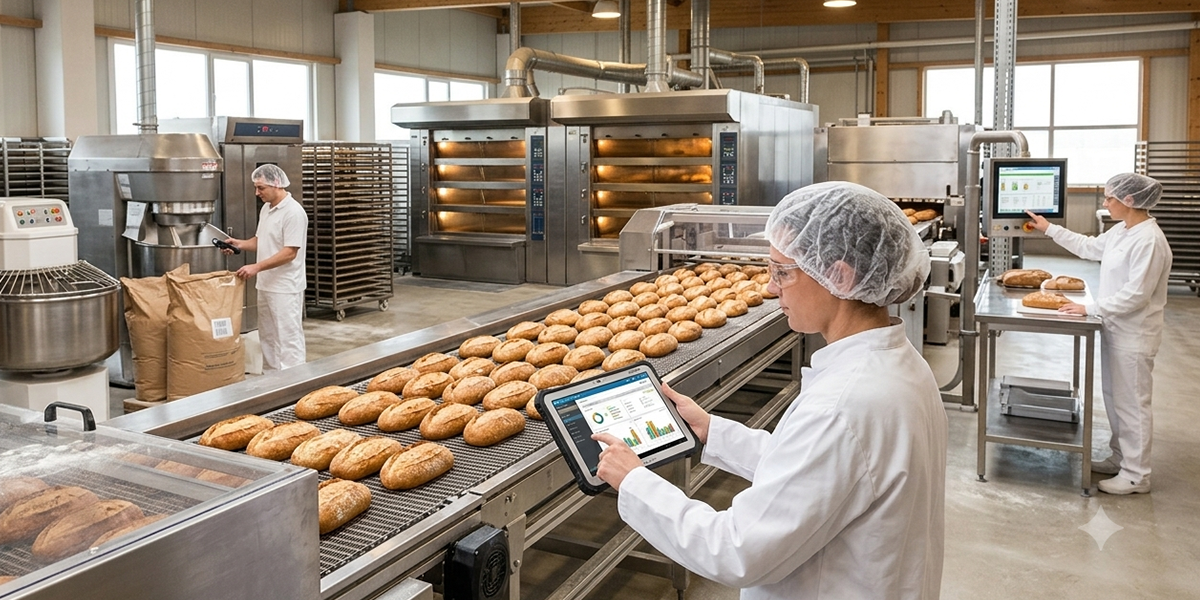
Before AI arrived, ERP systems were a breakthrough for Food & Beverage manufacturers. They replaced spreadsheets and manual registers with one unified system that brought better structure and visibility to daily operations. Food-oriented ERP systems use a modular approach that manages all supply chain activities from farm to fork.
ERP helped manage formulas and recipes, store multiple versions, and ensure that every batch met allergen, nutritional, and regulatory standards. It strengthened quality control through in-process checks, COA matching, quarantines, and full traceability, helping manufacturers detect issues early and maintain consistent product quality. It also helped reduce waste by improving expiry tracking, enforcing FEFO/FIFO, optimising inventory movement, and minimising material spoilage through better planning and storage control.
Production planning became easier with batch tickets, resource planning, and capacity-based scheduling. ERP also supported strict food regulations by maintaining batch records and making audits and mock recalls faster.
Indeed, Food ERP brought digital discipline across the plant, helping manufacturers improve quality and reduce wastage—though many decisions were still manual and reactive.
Challenges Traditional ERPs Faced
Even though ERP helped improve food manufacturing, it still had gaps that slowed operations, affected quality, and increased waste.
Operational Challenges
- ERP could store batch and production data, but couldn’t analyse it to spot recurring spoilage or shifts in demand.
- Decisions relied heavily on past data and team members, slowing responses during production.
- No way to predict ingredient shortages, batch failures, or seasonal demand spikes.
Inventory & Waste Challenges
- ERP tracked expiry dates but couldn’t predict spoilage for perishable ingredients.
- Couldn’t explain why certain materials kept going to waste.
- No alerts for overstock, slow-moving items, or products nearing expiry.
Quality & Compliance Challenges
- Quality issues were only noticed after the batch was made.
- ERP couldn’t identify repeated problems like taste, texture, or moisture variations.
- No early warnings for batches at risk of failing FSSAI, HACCP, or FDA standards.
Production & Planning Challenges
- Planning was basic and rule-based.
- ERP couldn’t forecast bottlenecks on mixers, ovens, or packaging lines.
- Sudden changes in demand required manual re-planning.
Supply Chain Challenges
- No real-time visibility into delayed ingredients or raw material shortages.
- Couldn’t suggest actions when vendor costs went up or transport got delayed.
- No ability to plan procurement based on future production or seasonal trends.
User & Decision-Making Challenges
- Heavy reliance on user experience to interpret reports.
- ERP showed data but didn’t explain what it meant for quality, yield, or waste.
- Plant and QC teams spent hours manually analysing issues.
What’s AI in ERP for Food
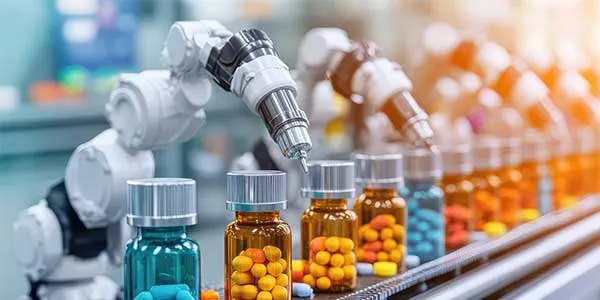
AI in the food industry uses smart technology and robotics to boost efficiency across the supply chain and production. It helps create new products, improve food quality and safety, and make sourcing easier.
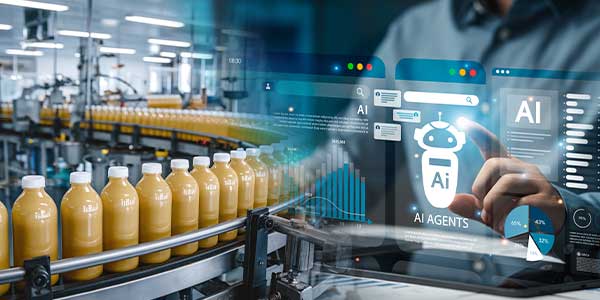
AI is becoming popular in food businesses because it can analyse huge amounts of data quickly. By integrating with ERP systems for food, it predicts demand, improves recipes, lowers production costs, and reduces food waste. One such AI ERP System is BatchMaster Web ERP. Let’s know about it in depth.
BatchMaster Web ERP for Food & Beverage – Now Smarter With AI
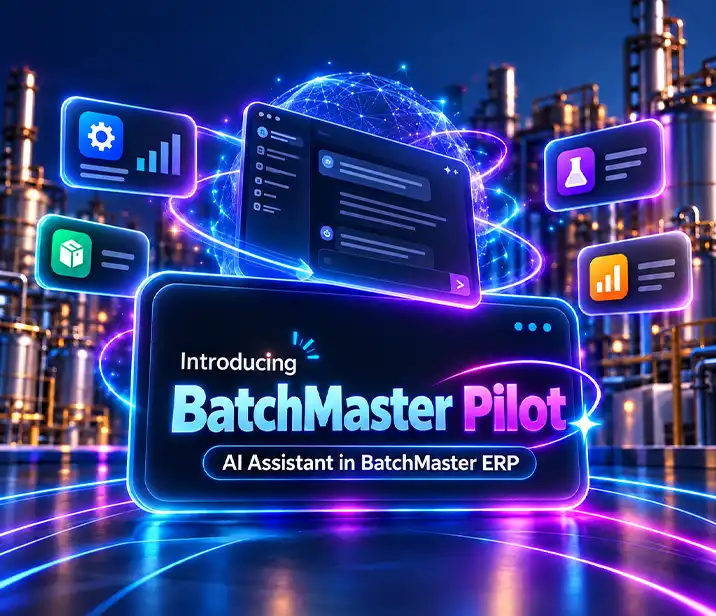
BatchMaster Web ERP brings AI into the core of the system, making it not just a tool for data entry, but a smart assistant for your daily operations. With added intelligence, it’s an AI ERP Software that makes everyday work faster, clearer, and far more accurate. For food and beverage manufacturers, this means:
Better batch quality | Less wastage | Improved quality | Tighter control – Across the entire supply chain.
Here’s how BatchMaster Web ERP transforms your operations:
1. Talk to AskBME and get instant help –
AskBME is BatchMaster’s built-in AI chatbot that instantly answers ERP-related questions, explains how features and modules work, and guides users through common tasks. It helps reduce training time for workers handling recipes, batches, and quality checks — how?
Workers don’t need long training or supervisor help. AskBME tells them exactly what to do—like how to start a batch, find a recipe, or perform a QC test—right when they need it. This helps new staff learn faster and work accurately from day one.
2. Accurate Sales & Demand Predictions
BatchMaster’s AI-powered sales forecasting analyses historical sales, festival trends, seasonality patterns, and demand behavior to predict what customers will need next. It highlights upcoming demand, recommends the right production quantities, and helps manufacturers avoid stockouts or excess inventory (especially of perishable items in dairy, bakery,etc.).
By giving food manufacturers a clear view of future requirements, it improves production, procurement, and labor planning—minimising waste, maximising fulfilment, and ensuring the entire supply chain runs smoothly and efficiently.
3. Smarter Recipe Development-
It helps R&D teams create or refine recipes using simple natural-language prompts, like: Make a low-sugar strawberry yogurt with natural sweeteners. The system instantly generates a draft formula along with nutritional values, cost impact, and suggested improvements.
This reduces the usual trial-and-error in R&D, cutting ingredient waste and ensuring consistent taste, texture, and quality across batches. It also supports clean-label, cost-optimised, and market-ready formulations, enabling manufacturers to innovate faster, reduce failed trials, and bring better products to market with confidence.
4. Smart Cash Flow Visibility
The software analyses studies financial trends specific to food manufacturing—where raw material prices fluctuate, seasonal demand shifts quickly, and procurement cycles impact working capital. It predicts upcoming cash inflows and outflows, highlights liquidity risks, and shows how sales patterns, ingredient purchases, and delayed customer payments affect overall cash health.
With early visibility into potential shortages, finance teams can plan procurement more effectively, secure inventory without overblocking cash, and maintain smooth operations across production and supply chain cycles.
These AI capabilities empower food manufacturers to reduce waste, improve production efficiency, and achieve consistent quality—batch after batch. Knowing that Food & Beverage manufacturing is complex, dynamic, and highly sensitive to errors, an AI-driven ERP brings the clarity and control manufacturers need.
BatchMaster Web ERP, powered by AI, not only manages day-to-day operations but also strengthens every decision behind them for safer, smarter, and more efficient food production. Request a demo of BatchMaster Web ERP powered by AI for Food & Beverage manufacturing.